
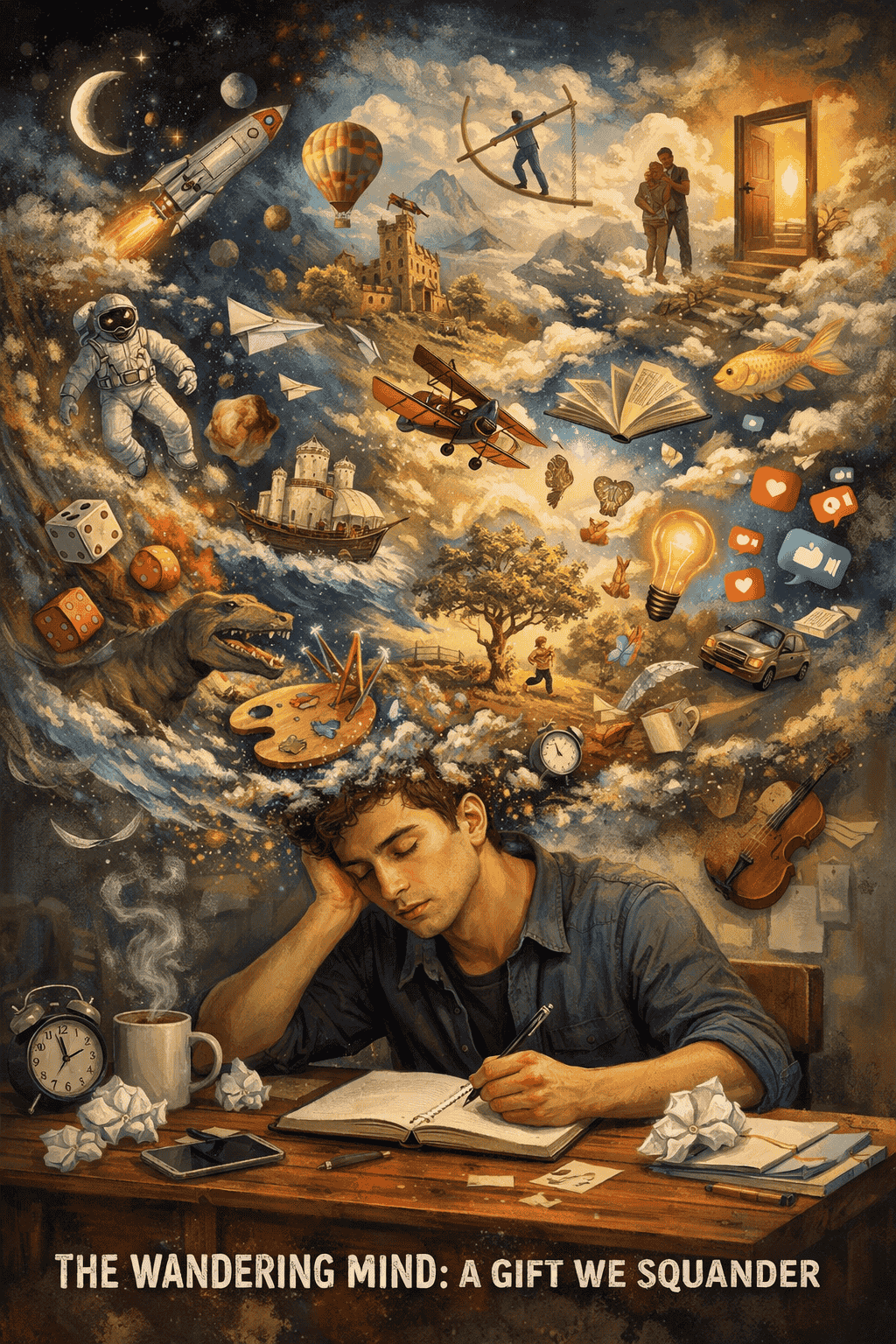

Many people see an unfocused mind as an issue. They view it as an opportunity to increase their production bucket.
- “Time to return working.”
- “Stop daydreaming.”
We’ve been trained to believe that if we’re not staring at a computer screen or crossing off our to-do lists that we’re in a state of failure.
However, Daniel Goleman, the psychologist who famously introduced Emotional Intelligence, argues the opposite in his book Focus:
“The mind’s wandering can be an inspiration for creative thoughts… It’s the issue isn’t that our brains wander, it’s that they get lost in the things that matter.”
This line is important because it exposes a current myth: You can’t be “on” all the all the time.
However, if you attempt to be “on” all day it’s hard to actually achieve more work.
It’s like you’re mentally tired, less creative and ironically, you are unable to concentrate when it really matters.
Your brain is equipped with two gears
Neuroscience reveals that the brain works in two fundamental ways.
- The Task-Positive Net (TPN): This is your “focus” gear. It’s activated when you’re solving an equation or creating reports.
- The default Mode Network (DMN): This is your “wandering” equipment. It comes on whenever you sleep, dream or contemplate the future.
The DMN is where magic takes place. It is responsible of “autobiographical planning”–making the most of your life’s events and linking different concepts.
“Time off” isn’t wasted time. It’s the integration.
It’s the process by which your brain connects the information you’ve fed it. If you don’t allow this stitching to take place it will result in a typical result of modern times: You’re working all day and nothing “clicks.”
There’s a renowned Harvard research study called “A Mind that is Wandering Mind is a unhappy Mind.” It discovered that when people’s minds wander, they frequently report feeling unhappy.
The majority of people use this as an excuse to end their daydreams. However, this is like saying that exercise isn’t good because your muscles become sore.
The problem isn’t in the wandering itself, it’s the uncontrolled roaming.
An anxious mind circling into circles of “what is the worst case scenario” can be a nightmare.
However, a restless mind that is wandering in a free flow of thoughts can lead to insight. The same thing happens however with different fuel.
One is fuelled by stress, the other is driven by curiosity.
Marcus Aurelius wrote about this almost two thousand years in the past:
“Nowhere is there an unflinchingly peaceful or tranquil sanctuary than the depths of his soul.”
However, Seneca included a crucial warning. He wrote, “Leisure without study is death. It’s an unfinished tomb for a alive man.”
The secret lies in the deliberate wandering.
Do not let your mind slide into the depths of stress. Allow it to think about the thoughts that are important.
The post-pandemic overcorrection
Why is it that so many of us are always agitated? What causes us to feel anxious when we wander for a while?
I am convinced it is likely that Covid played a major part in how our brains have evolved in the last few years.
The years 2020-2021 have been both very long. We’ve got a false picture of the past six years.
It’s been six years!
Most countries stayed in prison. And then slowly returning in 2022 and in 2023, it was nearly normal. However, since we were compelled to be in a state of limbo and do nothing and wander, we do not want to do that anymore.
I would say that the majority of people is in this constant condition of remaining “switched off” since we are still feeling the pain of being shut off.
After the restrictions were lifted We wanted to try as many things as possible.
The way we think has changed as a result of this.
We shouldn’t be slowing down as it makes us think of the fear of 2021 and 2020.
It’s a bit similar to PTSD
I still hear people talking about Covid as if it were yesterday. It’s as if they’re striving to squeeze every bit from their time before entering into the lockdown that is to come.
In the present everyone is trying to get rid of boredom.
However, when we take out boredom, we end the mind that wanders.
If we eliminate the mind that wanders and our capacity to invent.
How can you regain your natural rhythm, so that you can be more productive once again
It’s impossible to be focused all the time because you cannot stand on a plank all day long. Attention is an inexhaustible resource.
In the field of psychology, Attention Restoration Theory (ART) suggests that our “directed focus” (the TPN) is exhausted.
To correct this To fix it, we must have “soft attraction,” which is environments similar to nature that draw our attention with ease and without exertion.
If you’re looking to improve your focus, you’ll require more free time. This is not “cheap distracted” (social media) however, you need actual “off” space.
It’s not about becoming monks. The aim is to master your “switch.” It is important to be 100100 “on” when you’re ready to work while being 100 “off” when you’re ready to recharge.
Here’s how to develop to master that ability:
- Take advantage of 1 “dead zone” every week: Pick one activity–walking to your car, awaiting for your coffee to be served, or the traditional example of dishwashing. It’s all you need to do. No cell phone. No music. Simply let your mind drift.
- “The “Blank Walk”: 3 times per week take 20 minutes to walk without audio. The walk will be discomfort for at least the initial 5 minutes. This is it. It’s the “itch” of addiction to digital media and the body.
- Create the “Input cutoff”: Pick a date (e.g. at 8:00 pm) at which you cease to consume new information. There are no news or podcasts, not even “learning.” The brain needs time to process the information you acquired during the day.
- Keep an “Wandering Log”: Keep a small notebook, or one note on your smartphone. If an idea that is great comes up in the “off” moment, make sure you write it down as soon as you can and then return to your wandering.
The current status symbol is “busy.” It is our believe being available and well-informed all the time is what makes us worth having.
In actuality, it keeps us from becoming hungry.
It isn’t the enemy of concentration. It’s the base of it. If you’re looking to create superior work, you don’t require any more hustle. You’ll need more space.
Your brain is not running in a constant state of intensity. It is a rhythmic machine.




![Best Smartphones Under $500 in [2025]](https://www.fakoa.com/wp-content/uploads/2025/06/Best-Smartphones-Under-500-in-2025-150x150.jpg)